

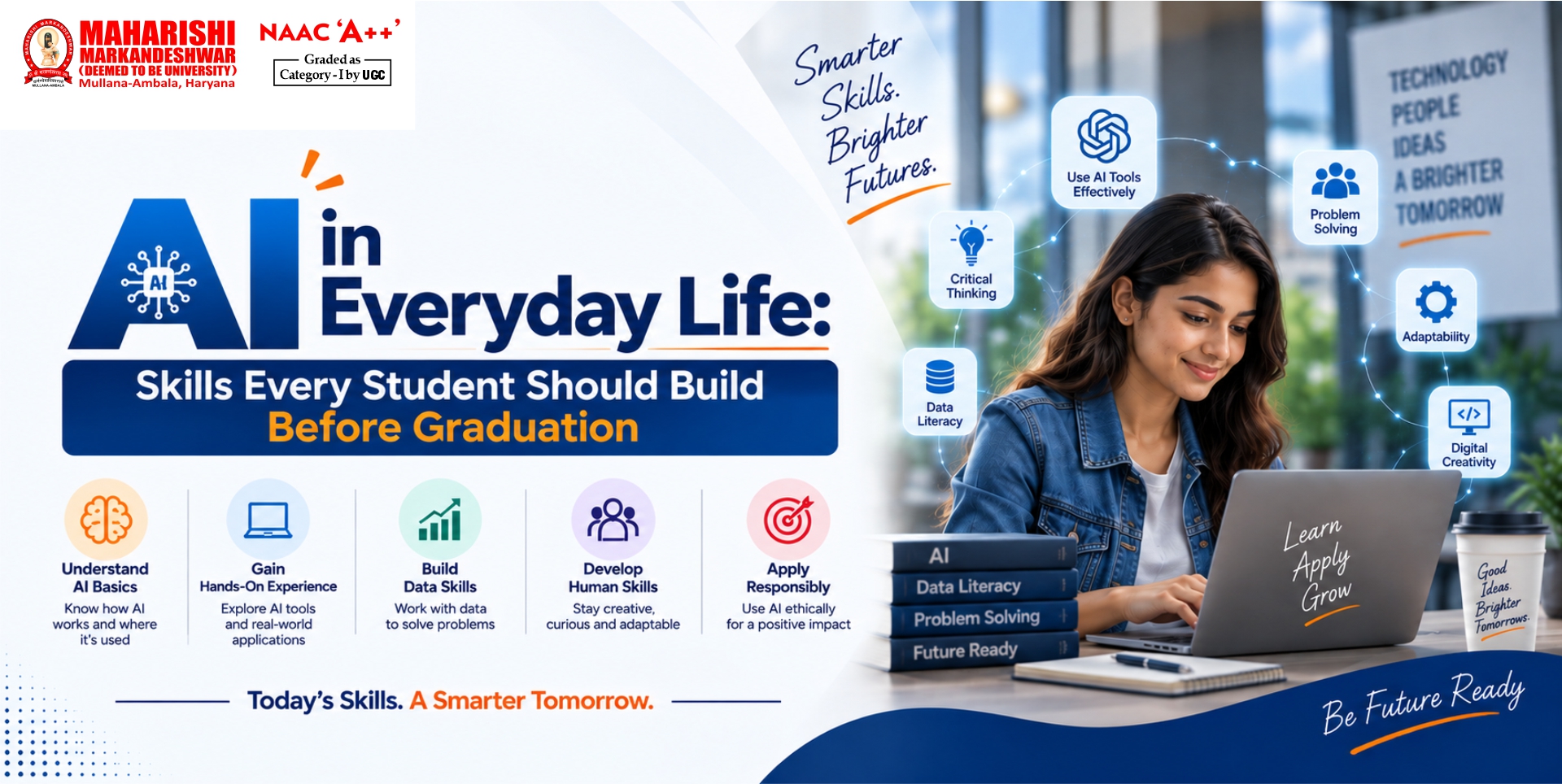
Artificial Intelligence (AI) is no longer a futuristic concept limited to research laboratories or technology companies. It has become part of everyday life… from search engines and digital assistants to personalised recommendations, online banking, healthcare, education and workplace tools. For today’s students, understanding AI is therefore becoming as important as developing communication, analytical and professional skills.
For students at MM(DU), Mullana this changing landscape presents an opportunity to prepare for careers where AI will increasingly influence how people work, solve problems and make decisions. Importantly, becoming AI-ready does not mean that every student needs to become an AI engineer. Instead, students across disciplines can develop the ability to understand, use and critically evaluate AI.
Understanding AI Beyond the Hype
The first skill students should develop is AI literacy.AI literacy means understanding what AI can do, where it can be useful and where its limitations lie. Students should become familiar with concepts such as machine learning, generative AI, automation, data and algorithms without necessarily needing to become programmers.For example, a management student may use AI to analyse business information, a law student may use it to organise research, an engineering student may use AI-assisted design tools, while a healthcare student may encounter AI in diagnostics, medical imaging and patient-care technologies.
At MM(DU), where students pursue programmes across engineering, medicine, management, law, pharmacy, nursing, computer applications, sciences and allied healthcare, understanding the role of AI within their respective fields can give them a valuable professional advantage.
Building Strong Digital Skills
AI works alongside digital technologies. Therefore, students should develop strong digital fluency before graduation.This includes knowing how to work with productivity software, online collaboration platforms, digital research tools, data visualisation applications and discipline-specific technologies.Students should also understand basic concepts such as cloud computing, cybersecurity, data privacy and digital communication. These skills can make students more adaptable as workplaces increasingly integrate AI-powered systems.
For an engineering or computer applications student, this may mean learning programming, databases, cloud platforms and AI tools. For students in management or commerce, it could involve spreadsheets, analytics and business intelligence. Healthcare students can focus on digital health technologies, electronic records and technology-assisted healthcare.
Learning to Ask Better Questions
One of the most valuable skills in the age of generative AI is effective prompting and questioning.AI tools can generate information, ideas, summaries and content within seconds. However, the quality of the output often depends on the quality of the instructions provided.
Students should learn how to clearly define a problem, provide relevant context, specify the desired outcome and evaluate the response. Instead of simply asking an AI tool to “write something,” students can learn to frame precise questions, request different perspectives and ask the system to explain its reasoning or identify assumptions.This skill is useful regardless of a student’s academic discipline.
A management student could use AI to brainstorm a marketing strategy. A law student could organise information for preliminary research. A science student could explore explanations of complex concepts. A computer science student could use AI as a coding assistant.
Developing Critical Thinking
Perhaps the most important skill students can develop before graduation is critical thinking.AI-generated information can sound convincing even when it is incomplete, inaccurate or inappropriate. Students therefore need to question the information they receive rather than accepting every AI-generated response at face value.This means checking sources, comparing information, identifying assumptions and recognising potential bias.
Higher education provides an ideal environment for developing these abilities. At MM(DU), students can use classroom learning, practical experiences, projects, discussions and research activities to develop the habit of questioning and validating information.
The future workplace will need professionals who can work with AI while still exercising independent judgement.
Strengthening Communication Skills
It may seem surprising, but the rise of AI makes human communication skills even more valuable.AI can generate emails, reports and presentations, but effective professionals still need to communicate ideas, understand people, collaborate with teams and make decisions.
Students should therefore focus on written and verbal communication, presentation skills, listening and interpersonal abilities.Whether a student is studying medicine, engineering, management, law or healthcare, the ability to explain a complex idea clearly can make a significant difference to professional success.
AI can help students improve their writing and presentation, but it cannot replace the need to develop their own voice and judgement.
Learning Data Literacy
AI depends heavily on data, making data literacy an increasingly valuable skill.Students should understand how data is collected, organised, interpreted and presented. They should be able to distinguish between meaningful patterns and misleading conclusions.Students from technology-related programmes may progress towards advanced data analytics, machine learning and programming. Others can develop practical skills in reading charts, analysing trends and using data to support decisions.
For management students, data literacy can support business decision-making. For healthcare students, it can contribute to understanding patient and clinical data. For researchers, it can strengthen evidence-based analysis.The depth may differ by discipline but the ability to understand data is increasingly relevant across careers.
Understanding Ethics, Privacy and Responsible AI
With greater use of AI comes greater responsibility.Students should understand the ethical questions surrounding AI, including privacy, bias, misinformation, intellectual property, academic integrity and responsible use of personal data.
For instance, using AI to understand a difficult topic can support learning, while submitting AI-generated work as one’s own may undermine academic integrity. Similarly, AI-generated information should not automatically be treated as professional advice in sensitive fields such as healthcare or law.
Being a Lifelong Learner
Perhaps the biggest lesson of the AI era is that learning does not end at graduation.AI tools and technologies are evolving rapidly. A tool that is popular today may be replaced by something more advanced tomorrow. Students therefore need to develop adaptability and a willingness to keep learning.Universities can provide the foundation but professionals must continue upgrading their skills throughout their careers.
Students at MM(DU) can use their university years to experiment with new technologies, participate in projects, collaborate across disciplines and explore how AI can be applied to real-world challenges.
Preparing for an AI-Enabled Future
AI will not affect every profession in exactly the same way, but it is likely to influence almost every sector. The students best prepared for this future will not necessarily be those who know the most about AI. They will be those who know how to learn, question, adapt and use technology responsiblyBefore graduation, every student should aim to build a combination of AI literacy, digital skills, critical thinking, communication, data literacy, ethical awareness and domain expertise.
At MM(DU), students have the opportunity to build these capabilities alongside their academic and professional education. The objective is not simply to prepare students for their first job, but to help them develop the confidence and adaptability required for a rapidly changing world.AI may shape the future of work, but human curiosity, creativity, judgement and empathy will continue to shape the future itself.

