

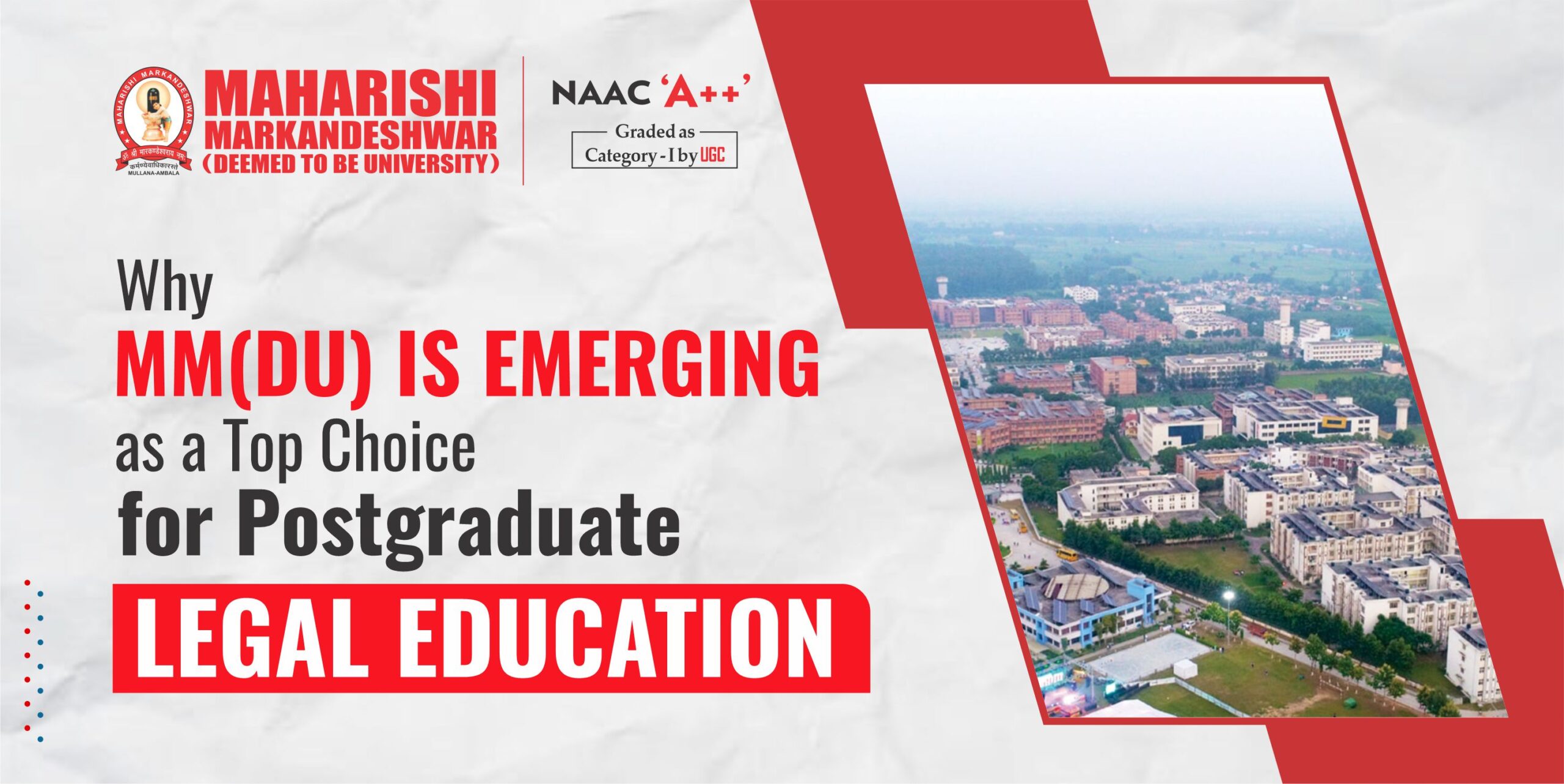
MM(DU) (Maharishi Markandeshwar (Deemed to be University)) is increasingly being seen as a strong destination for postgraduate legal education especially for students who want an LLM experience that is not only classroom-heavy but also research-driven, skill-oriented and aligned with today’s legal market realities. In an era where legal practice is being reshaped by technology, policy churn, corporate compliance, and cross-border work, a postgraduate law programme must offer more than “advanced theory.” It must create specialists who can think critically, write persuasively, research rigorously, and apply the law confidently in real-world contexts. This is where MM(DU) is steadily building its reputation.
1) A postgraduate learning ecosystem, not just a degree
One of the biggest reasons students gravitate toward MM(DU) is that the university ecosystem supports postgraduate learning across disciplines. PG legal education thrives when law students can interact with management, healthcare, engineering, and social sciences—because modern legal problems rarely sit in one silo. Questions around medical negligence, cybercrime, data privacy, fintech regulation, environmental clearances, education policy, labour compliance and consumer protection often demand an interdisciplinary lens.
At MM(DU), the campus environment and academic culture encourage this broader orientation. For LLM students, this matters: your dissertation, seminar papers, and publication work become sharper when you can access diverse perspectives and research cultures around you. A postgraduate law student benefits immensely from being in a university where research and professional development are part of the larger institutional DNA.
2) Strong focus on legal research, writing, and publication culture
Postgraduate law is fundamentally research-centric. Students choose an LLM to deepen expertise, learn advanced research methods, and potentially move toward academia, policy, or high-level practice. MM(DU)’s emerging strength lies in encouraging a research and writing culture that goes beyond end-semester submissions.
The focus is increasingly on:
- learning how to frame a research problem,
- developing a methodology and literature review,
- improving citation discipline and academic integrity,
- writing publishable-quality seminar papers,
- and working on dissertations that are relevant to legal practice and policy trends.
3) Curriculum aligned with contemporary legal realities
A top-tier postgraduate legal programme must reflect where the legal profession is headed, not where it has been. MM(DU)’s growing appeal is also linked to its emphasis on areas that are increasingly central to law careers today such as constitutional debates in governance, corporate and commercial law applications, ADR (alternative dispute resolution), criminal justice reforms, technology and cyber law concerns and evolving approaches to human rights and social justice.
The point is not merely to “add new subjects,” but to build the habit of legal updating: tracking judgments, reading policy notes, following legislative changes, and learning how to interpret grey areas. Students who graduate with this mindset adapt faster in litigation chambers, corporate legal teams, regulatory bodies and academia.
4) Skill-building: advocacy, drafting, research tools and argumentation
LLM students often realise that advanced knowledge alone is not enough. What makes a postgraduate truly stand out is how well they can translate that knowledge into legal outputs drafts, opinions, research notes, arguments, policy briefs and structured legal writing.
MM(DU)’s emerging position is tied to its emphasis on practical and professional competencies alongside theory. Postgraduate legal education is increasingly expected to cover:
- advanced legal drafting and interpretation,
- case analysis and precedent mapping,
- research databases and digital research methods,
- courtroom and arbitration-oriented reasoning,
- and structured argumentation with clarity and evidence.
When this becomes part of the academic routine—through seminars, workshops, assignments and guided feedback… students see a tangible improvement in confidence and employability.
5) Mentoring and academic support that matters at PG level
At postgraduate level, what students need most is mentoring—someone to guide them on topic selection, research scope, dissertation structure and publication strategy. Many students struggle not because they lack intelligence, but because they don’t get consistent academic direction.
MM(DU) is becoming attractive to PG law aspirants because it aims to provide a more guided pathway for serious academic work. When faculty mentorship is accessible and the academic process is structured.
6) Competitive peer environment and professional exposure
A strong LLM environment depends heavily on peer learning. Discussions become richer when classrooms include diverse learners, fresh graduates, working professionals, litigation-oriented students and those aiming for academia. MM(DU)’s PG appeal is also linked to the way it is building a more competitive peer culture: students who are serious about debates, seminars, mooting/research presentations and building a profile.
Professional exposure matters too. Guest lectures, legal awareness events, seminars with practitioners and academic conferences provide students the opportunity to learn directly from the field and build networks early. At PG level, even small networking opportunities can lead to internships, research assistant roles, conference presentations and recommendations.
7) Career relevance: pathways beyond traditional litigation
The legal profession today offers a wide menu of careers beyond courtroom practice: corporate compliance, contract management, data protection roles, policy research, legal operations, arbitration support, risk advisory and academic research. A postgraduate program that acknowledges and prepares students for these trajectories becomes instantly more valuable.MM(DU)’s emerging stature as a PG law choice is tied to this broader employability lens. Students increasingly want a programme that can help them:
- build a research profile (publications, conference papers),
- prepare for academic exams and interviews,
- strengthen drafting and analysis skills for corporate roles,
- and develop clarity on specialisations for long-term career growth.
A postgraduate law student needs library time, reading culture, peer discussions and the mental space to produce long-form academic work. MM(DU) offers a campus-driven academic atmosphere that supports structured learning, regular evaluations, and consistent engagement. When students have access to academic resources and a routine that encourages discipline, they tend to achieve better outcomes.
MM (DU) is emerging as a top choice for postgraduate legal education because it is increasingly offering what today’s LLM students actually need: interdisciplinary exposure, research depth, modern curriculum orientation, skill-building, mentorship, and career relevance. For aspiring academics, policy researchers, corporate legal professionals, and litigation-oriented learners alike, the university is steadily positioning itself as a place where postgraduate law is treated as a serious professional and intellectual pathway.
So if you are also keen to shape up your career in law; visit this link for more details of the courses and eligibility criteria.

