

Artificial Intelligence (AI) is no longer a futuristic concept. It is already transforming how we live, work, communicate, shop, travel and even receive healthcare. From recommendation engines on streaming platforms to self-driving vehicles and intelligent healthcare systems, AI is becoming the foundation of the next wave of innovation.
As industries rapidly adopt AI-driven technologies, the demand for skilled professionals has grown significantly. A B.Tech in Artificial Intelligence & Machine Learning is designed to prepare students for this evolving landscape by combining strong engineering fundamentals with practical AI applications. At MMEC), MM(DU), students receive industry-focused education that goes beyond textbooks. The programme is structured to help learners develop technical expertise, analytical thinking, and hands-on experience required to build intelligent systems that solve real-world problems.
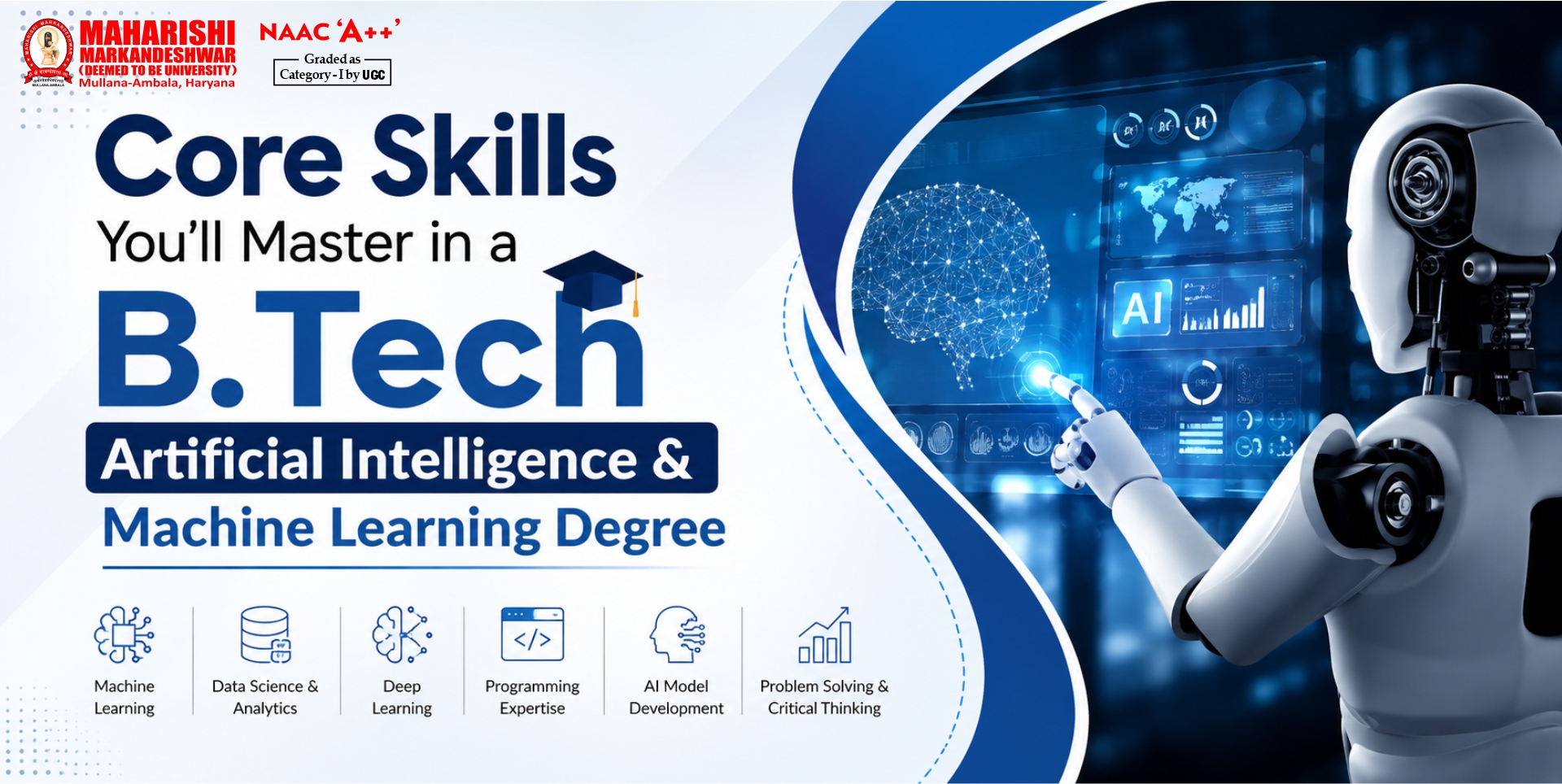
Here are the core skills student’s masters during a B.Tech in AI & Machine Learning.
1. Programming and Software Development – Every AI professional begins with a strong programming foundation. Students learn widely used programming languages such as Python, Java, and C++, enabling them to develop efficient applications and intelligent software solutions.Python, in particular, plays a central role in AI development because of its simplicity and extensive ecosystem of AI libraries.Students also learn software engineering principles including debugging, version control, modular programming, and collaborative development practices that prepare them for professional environments.
2. Mathematics Behind Artificial Intelligence –AI is powered by mathematics. Concepts such as linear algebra, calculus, probability and statistics form the backbone of machine learning algorithms.Instead of memorising formulas, students learn how mathematical models help computers identify patterns, make predictions and improve decision-making.Understanding these concepts enables graduates to build better AI models and troubleshoot them effectively.
3. Machine Learning Algorithms – Machine Learning is one of the most important components of the programme.Students explore supervised learning, unsupervised learning, reinforcement learning, regression, classification, clustering and recommendation systems. They learn not just how to use algorithms but also how to choose the right algorithm for different business and engineering problems.Practical projects expose students to real datasets, helping them understand how AI performs outside classroom environments.
4. Deep Learning and Neural Networks – Modern AI applications such as voice assistants, facial recognition, autonomous vehicles, and language translation rely heavily on deep learning.Students learn about artificial neural networks, convolutional neural networks (CNNs), recurrent neural networks (RNNs), transformers and advanced deep learning architectures.Hands-on implementation using industry-standard frameworks enables students to create intelligent systems capable of processing complex information.
5. Data Science and Data Analytics – Data is often called the fuel of AI.Students learn how to collect, clean, organise, visualise and analyse large datasets before building predictive models.They work with structured and unstructured data using modern analytical tools and libraries.The ability to extract meaningful insights from data is valuable across industries including finance, healthcare, retail, manufacturing, agriculture and public administration.
6. Natural Language Processing (NLP) – Human language is complex and enabling computers to understand it requires specialised techniques.Natural Language Processing teaches students how machines process text and speech. Applications include chatbots, virtual assistants, translation systems, sentiment analysis, document summarisation and intelligent search engines.With the rise of Generative AI and large language models, NLP has become one of the fastest-growing areas in technology.
7. Computer Vision – Computer Vision allows machines to understand images and videos.Students learn image processing, object detection, facial recognition, image classification, and video analytics.These skills are widely used in healthcare diagnostics, manufacturing quality inspection, autonomous vehicles, agriculture, defence, surveillance and smart cities.Working on vision-based projects also strengthens practical AI implementation skills.
8. Cloud Computing and AI Deployment – Building an AI model is only part of the job.Students also learn how to deploy AI applications using cloud platforms and scalable computing environments.They understand concepts like APIs, cloud infrastructure, model deployment, and AI services that make solutions accessible to businesses and users worldwide.This practical exposure bridges the gap between classroom learning and industry implementation.
9. Problem Solving and Critical Thinking – Artificial Intelligence is ultimately about solving problems.Students are trained to analyse complex challenges, identify patterns, evaluate multiple approaches and design practical solutions.Project-based learning encourages innovation while improving logical reasoning and decision-making abilities.These transferable skills remain valuable regardless of future technological changes.
10. Ethics and Responsible AI – As AI becomes more powerful, ethical responsibility becomes equally important.Students study fairness, transparency, privacy, bias in algorithms, cybersecurity considerations and responsible AI development.Understanding ethical AI helps future engineers create technologies that are trustworthy, inclusive and socially responsible. Organisations increasingly seek professionals who can balance innovation with accountability.
Learning Through Practical Experience
One of the biggest advantages of studying AI today is the opportunity to work on real-world applications throughout the programme.At MMEC, MM(DU), students are encouraged to participate in hands-on laboratories, coding competitions, hackathons, innovation projects, internships, and industry interactions.This experiential approach helps students apply classroom concepts to practical challenges while developing confidence and technical proficiency.Working on live projects also enhances teamwork, communication, and project management skills that employers value highly.
Career Opportunities after B.Tech AI & Machine Learning
Graduates possess a versatile skill set that opens doors across multiple industries.Career opportunities include:
- Machine Learning Engineer
- Artificial Intelligence Engineer
- Data Scientist
- AI Research Associate
- Computer Vision Engineer
- NLP Engineer
- Robotics Engineer
- Business Intelligence Analyst
- AI Consultant
- Software Development Engineer
As AI adoption accelerates globally, professionals with specialised knowledge are expected to remain among the most sought-after technology talent.
Why Choose MMEC, MM(DU)?
Pursuing a B.Tech degree requires choosing an institution that combines academic excellence with industry relevance. MM (DU) offers a learning environment designed to prepare students for the rapidly evolving technology sector. The curriculum blends engineering fundamentals with emerging AI technologies, while experienced faculty, modern laboratories, project-based learning, research opportunities and industry exposure ensure students graduate with both theoretical knowledge and practical expertise.
The university’s focus on innovation, entrepreneurship, interdisciplinary learning, and professional development helps students become future-ready engineers capable of contributing meaningfully to the AI-driven economy. You can visit this link for more details on B.Tech in Artificial Intelligence & Machine Learning.

