


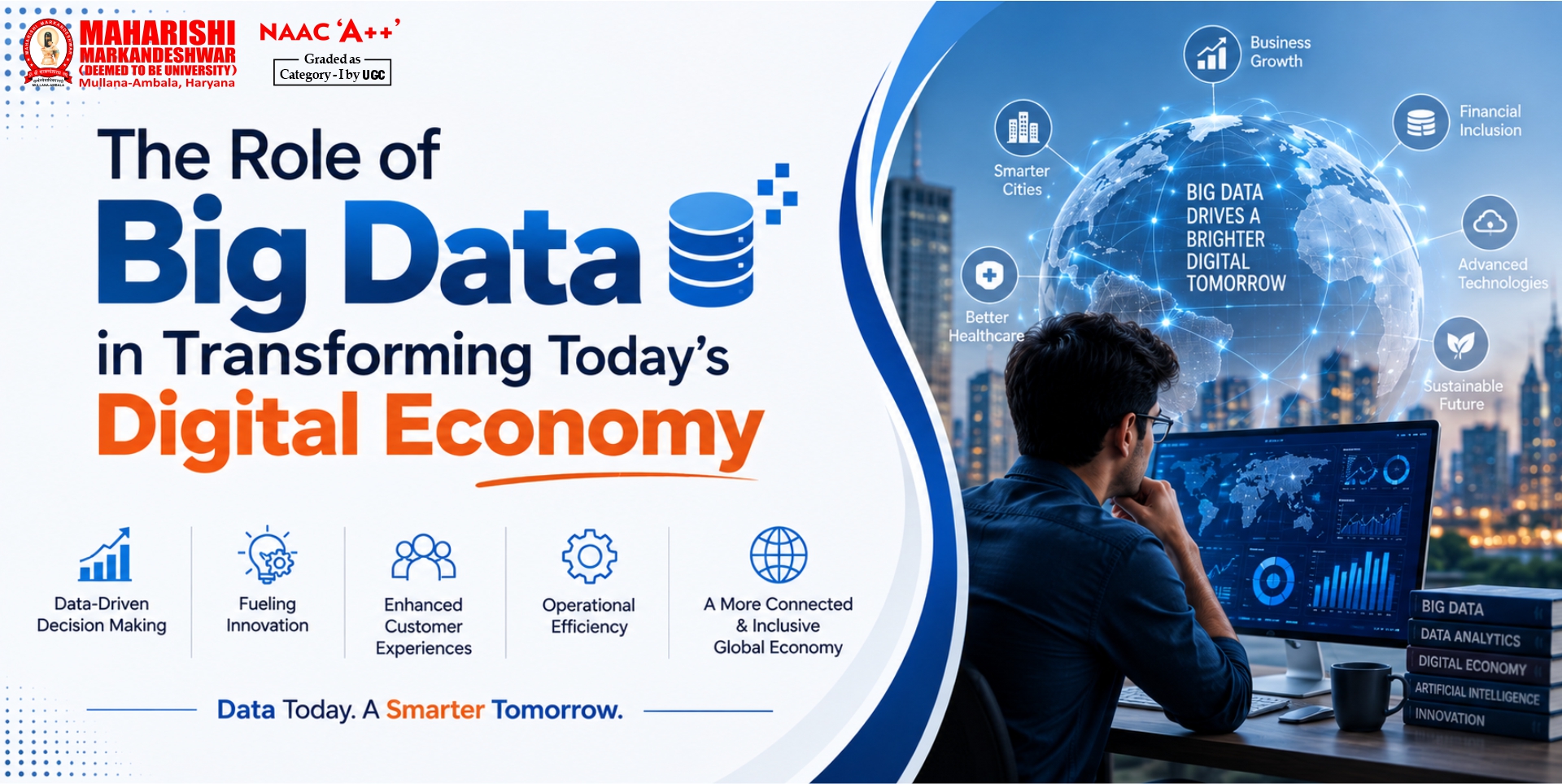
In today’s hyper-connected world, data has become one of the most valuable resources, often referred to as the “new oil.” Every online search, social media interaction, digital payment, GPS location, healthcare record and e-commerce transaction generates enormous volumes of data every second. This unprecedented explosion of information is known as Big Data, and it is fundamentally transforming the way businesses operate, governments make decisions, and societies function. From predicting customer preferences to improving healthcare outcomes and strengthening cybersecurity, Big Data has emerged as the driving force behind the modern digital economy.
Understanding Big Data
Big Data refers to extremely large and complex datasets that cannot be processed efficiently using traditional data management tools. It is typically defined by the five Vs:
- Volume: Massive quantities of data generated every second.
- Velocity: The speed at which data is created and processed.
- Variety: Different forms of data, including structured, semi-structured, and unstructured data.
- Veracity: The reliability and accuracy of data.
- Value: The actionable insights that organizations derive from data.
The real power of Big Data lies not merely in collecting information but in analysing it to identify patterns, predict trends, and support informed decision-making.
Big Data: The Backbone of the Digital Economy
The digital economy thrives on information. Organizations today rely on data-driven strategies rather than intuition to make business decisions. Big Data enables companies to understand customer behaviour, optimize operations, reduce costs and identify new growth opportunities.Digital platforms such as e-commerce websites, fintech companies, streaming services, and social media platforms continuously analyse user behaviour to provide personalized experiences. Every recommendation you receive on an online shopping platform or every movie suggested by a streaming service is powered by sophisticated Big Data analytics.
Businesses that effectively leverage Big Data gain a significant competitive advantage by making faster and smarter decisions.
Revolutionizing Business Operations
Big Data has transformed nearly every aspect of business management.
Companies now use predictive analytics to forecast demand, optimize inventory, and improve supply chain efficiency. Retailers can anticipate customer purchasing trends before products go out of stock. Manufacturers use sensor-generated data to predict equipment failures, reducing maintenance costs and preventing production downtime.
Marketing has also become far more targeted. Instead of broad advertising campaigns, businesses use customer data to deliver personalized advertisements based on browsing history, purchase patterns, demographics, and interests. This significantly improves customer engagement and return on investment.
Financial institutions leverage Big Data to detect fraudulent transactions, assess credit risks, and automate financial services, making banking more secure and efficient.
Driving Innovation Across Industries
Big Data has become a catalyst for innovation across multiple sectors.
Healthcare – Healthcare providers use Big Data to analyse patient records, monitor disease outbreaks, develop personalized treatment plans and improve hospital management. Wearable devices continuously generate health data, allowing doctors to monitor patients remotely and intervene before medical conditions worsen.
Education – Educational institutions analyse student performance data to personalize learning experiences, identify learning gaps and improve academic outcomes. Learning management systems use analytics to recommend study materials tailored to individual students.
Agriculture – Modern agriculture relies heavily on data collected through drones, satellites, sensors and weather monitoring systems. Farmers use predictive analytics to optimize irrigation, improve crop yields, and reduce resource wastage.
Manufacturing – Industry 4.0 has integrated Big Data with Artificial Intelligence (AI), the Internet of Things (IoT), and automation. Smart factories use real-time data to monitor production lines, improve quality control, and maximize operational efficiency.
Big Data and Artificial Intelligence
Big Data serves as the foundation for Artificial Intelligence and Machine Learning. AI systems require enormous amounts of high-quality data to learn patterns and improve decision-making.Applications such as voice assistants, autonomous vehicles, fraud detection systems, recommendation engines, and facial recognition technologies all depend on Big Data. As AI continues to evolve, the demand for skilled professionals capable of collecting, managing and analysing large datasets will continue to rise. The synergy between Big Data and AI is expected to redefine industries over the next decade by enabling intelligent automation and predictive decision-making.
Supporting Smart Governance
Governments worldwide are increasingly using Big Data to improve public services and policy-making.Data analytics helps authorities manage traffic congestion, monitor pollution levels, improve disaster response, strengthen law enforcement, and enhance public healthcare systems. During public health emergencies, Big Data enables authorities to track disease spread, allocate medical resources efficiently and make evidence-based policy decisions.
Smart city initiatives also rely on Big Data to optimize transportation systems, energy consumption, waste management, and urban planning, making cities more sustainable and citizen-friendly.
Challenges in the Era of Big Data
Despite its immense potential, Big Data presents several challenges.
- Data privacy remains one of the biggest concerns. As organizations collect vast amounts of personal information, ensuring secure storage and responsible use of data becomes essential. Cybersecurity threats, data breaches, and identity theft continue to pose significant risks.
- Another challenge is the shortage of skilled professionals capable of managing complex datasets and developing advanced analytical models. Organizations increasingly seek experts who possess knowledge of data engineering, machine learning, cloud computing, database management, and business intelligence.
- Ethical use of data is equally important. Algorithms must remain transparent, unbiased, and accountable to ensure fairness in automated decision-making.
Career Opportunities in Big Data
The rapid growth of digital transformation has created an enormous demand for Big Data professionals across industries.
Popular career options include:
- Data Analyst
- Data Scientist
- Big Data Engineer
- Machine Learning Engineer
- Business Intelligence Analyst
- Data Architect
- Cloud Data Engineer
- AI Specialist
- Database Administrator
- Analytics Consultant
Professionals with expertise in Big Data often enjoy attractive salary packages and global career opportunities across sectors such as IT, banking, healthcare, manufacturing, telecommunications, retail, and government.
As technologies like Artificial Intelligence, the Internet of Things (IoT), blockchain, cloud computing and 5G continue to evolve, the volume of data generated worldwide will grow exponentially. Organizations that can effectively collect, process, and interpret this data will shape the future of the global economy.
As industries increasingly rely on data-driven decision-making, there is a growing demand for professionals equipped with advanced analytical and technological skills. Maharishi Markandeshwar (Deemed to be University) (MM (DU)) prepares students for this evolving landscape through industry-oriented programmes that combine strong theoretical foundations with practical exposure. The university offers undergraduate and postgraduate programmes in Computer Science, Data Science, Artificial Intelligence & Machine Learning, Information Technology, Computer Applications (BCA and MCA) and related engineering disciplines, where students gain hands-on experience with data analytics, programming, cloud technologies, and emerging digital tools. With experienced faculty, modern laboratories, research opportunities, and strong industry collaborations, MM(DU) empowers aspiring professionals to build successful careers in the rapidly expanding field of Big Data and the digital economy. Visit this link to know more about Big Data courses offered by MM(DU).

