


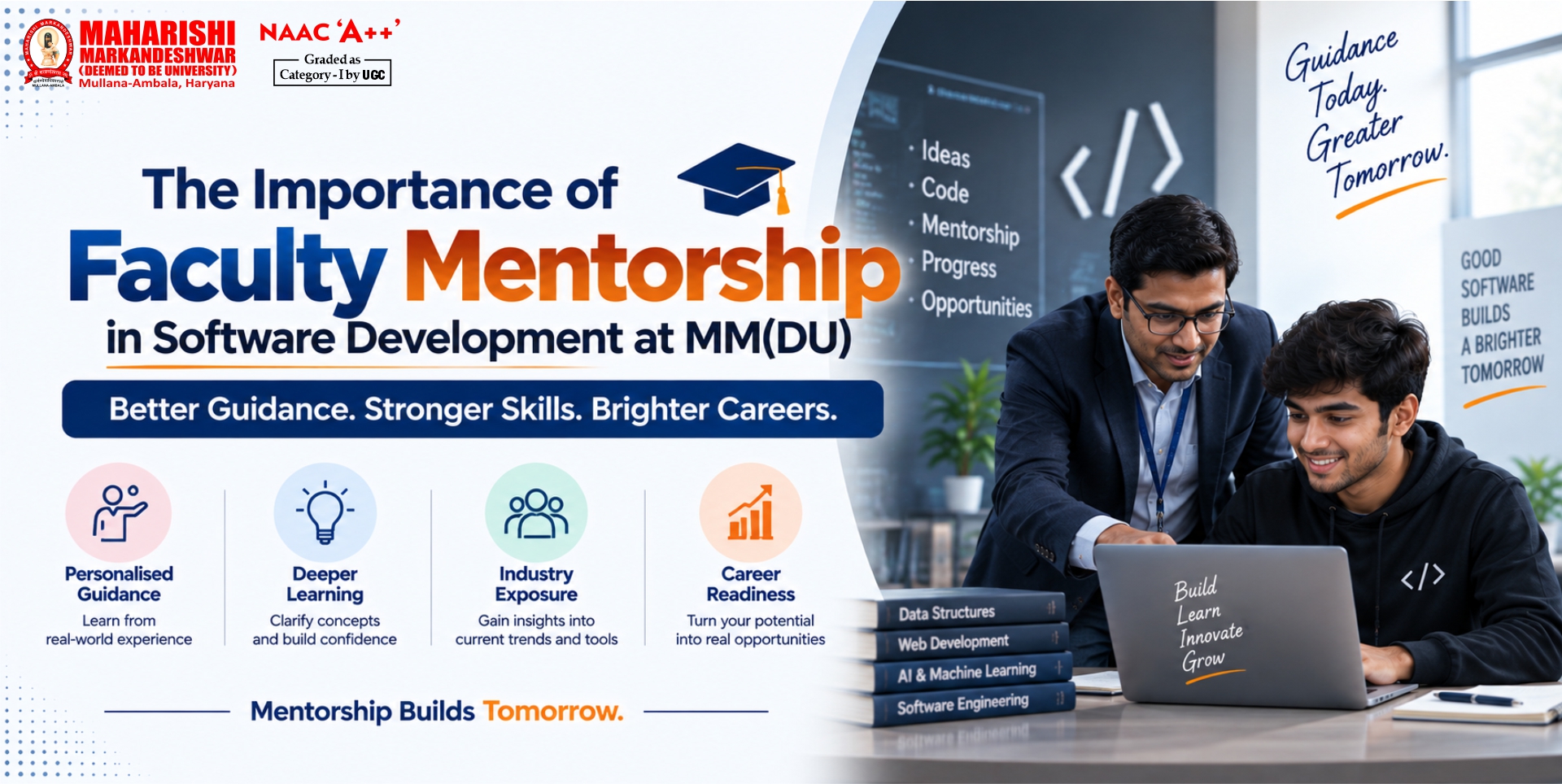
Software development is one of the fastest-evolving fields in the world. Programming languages change, technologies emerge almost every day, and skills that are highly sought after today can evolve significantly within a few years. In such an environment, learning software development cannot be limited to textbooks, classrooms or coding exercises. Students need guidance that helps them understand not only how to code, but also how to think, solve problems, adapt, collaborate, and build technology that creates real-world value. This is where faculty mentorship becomes especially important.
At MM(DU), faculty mentorship can play a significant role in helping students transform their academic knowledge into professional capability. A strong mentor does much more than teach a programming language or explain a technical concept. A mentor becomes a guide who helps students discover their strengths, overcome challenges, make informed career choices, and develop the confidence required to succeed in the software industry.
Beyond the Classroom: Turning Knowledge into Application
Software development is fundamentally practical. A student may understand programming concepts theoretically, but applying those concepts to a real problem requires a different level of understanding.Faculty mentors help bridge this gap between theory and application. Through projects, coding assignments, laboratory work, hackathons, internships, and problem-solving exercises, mentors can encourage students to ask the right questions and approach problems systematically.
For instance, rather than simply teaching students how to write code, a mentor can challenge them to think about why a particular solution is efficient, how it could be improved, what happens when the scale increases, and how the solution would work in a real-world environment. Such discussions develop computational thinking and analytical abilities… skills that remain valuable regardless of which technology or programming language a student eventually chooses.
Personalised Guidance for Different Learning Needs
Every student enters a software development programme with a different background. Some may have been coding since school, while others may discover programming for the first time at university. Some may excel at problem-solving, while others may have stronger interests in design, artificial intelligence, cybersecurity, data science, cloud computing, or application development. Faculty mentors can identify areas where individual students need additional support and encourage them to explore areas where they show particular potential. Regular interaction can help students understand their learning gaps and create realistic goals for improvement.
Building Problem-Solving and Critical Thinking Skills
Good software developers are not merely good coders. They are good problem-solvers.
In professional environments, developers rarely receive problems with straightforward answers. They have to understand requirements, identify constraints, evaluate alternatives, anticipate challenges, and develop solutions that are practical and scalable.Faculty mentors can cultivate these abilities by encouraging students to look beyond the first solution that comes to mind. Asking questions such as “Is there a better approach?”, “What happens if the input increases?”, or “Can this be made more efficient?” encourages students to develop a critical mindset.
This culture of questioning is particularly valuable in technology because innovation often begins with challenging existing assumptions.
Mentorship and Career Readiness
One of the biggest challenges students face is understanding how academic learning translates into a career.The software industry offers a wide range of opportunities, from software engineering and web development to artificial intelligence, machine learning, cloud computing, cybersecurity, data analytics, and emerging technology domains. With so many choices, students can sometimes find it difficult to identify the path that suits their interests and abilities.
Faculty mentors can provide valuable direction by helping students understand different career options and the skills associated with them. They can also guide students in selecting projects, certifications, internships, competitions and additional learning opportunities that complement their academic programme.Mentorship can further contribute to placement preparation by helping students improve technical fundamentals, communication skills, presentation abilities, problem-solving approaches and interview readiness.
Encouraging Projects, Innovation and Industry Thinking
Software development becomes meaningful when students build something.A strong mentorship culture encourages students to move beyond prescribed assignments and experiment with their own ideas. Faculty members can help students convert an idea into a project by guiding them through problem identification, technology selection, development, testing, documentation, and presentation.
Such projects can also expose students to the realities of software development: debugging, version control, collaboration, deadlines, user requirements, and continuous improvement.
At MM(DU), opportunities for project-based learning and interdisciplinary collaboration can help students understand that technology does not exist in isolation. Software can be used to address challenges across healthcare, education, agriculture, business, finance, sustainability, and numerous other sectors.
Developing Professional Values
Technology skills may open the door to a career, but professional values determine how students grow within it.
Faculty mentors can help students understand the importance of ethics, responsibility, teamwork, communication, intellectual curiosity, and continuous learning. These qualities are particularly important in software development because technology can have a significant impact on individuals and society.
A mentor who encourages students to document their work properly, respect intellectual property, acknowledge sources, work collaboratively, and take responsibility for the quality of their code is helping them develop habits that extend far beyond university.
Preparing Students for a Changing Future
The most important lesson a mentor can teach a software development student may be how to keep learning.No university curriculum can remain permanently aligned with an industry that changes so quickly. Students therefore need the ability to learn new technologies independently, adapt to new environments, and remain curious throughout their careers.
Faculty mentorship helps establish this mindset. Instead of preparing students only for their first job, effective mentors prepare them for a professional journey in which learning never stops.
For students at MM(DU), this combination of academic learning, practical exposure, personalised guidance, innovation, and mentorship can create a strong foundation for careers in software and emerging technologies.
Ultimately, the role of a faculty mentor extends far beyond teaching code. A mentor helps students understand possibilities, question assumptions, navigate challenges, and believe in their ability to build solutions.
In software development, technologies will continue to change. Programming languages will evolve. New platforms will emerge. But the ability to think critically, learn continuously, solve meaningful problems, and adapt with confidence will always remain relevant.
That is the real value of faculty mentorship: it does not simply prepare students to write better code; it prepares them to become better technology professionals.
Visit this link to know more about the admission process and eligibility criteria for software development programs.

