

The technology industry is changing faster than ever. New tools, programming languages, frameworks and digital platforms continue to emerge, creating exciting opportunities for students who are ready to build careers in technology. But succeeding in this environment requires more than knowing how to write code. Today’s employers look for professionals who understand how technology works as a complete system, can solve real-world problems and are ready to contribute from day one.This is where a strong, industry-oriented Full Stack Development curriculum can make a meaningful difference.
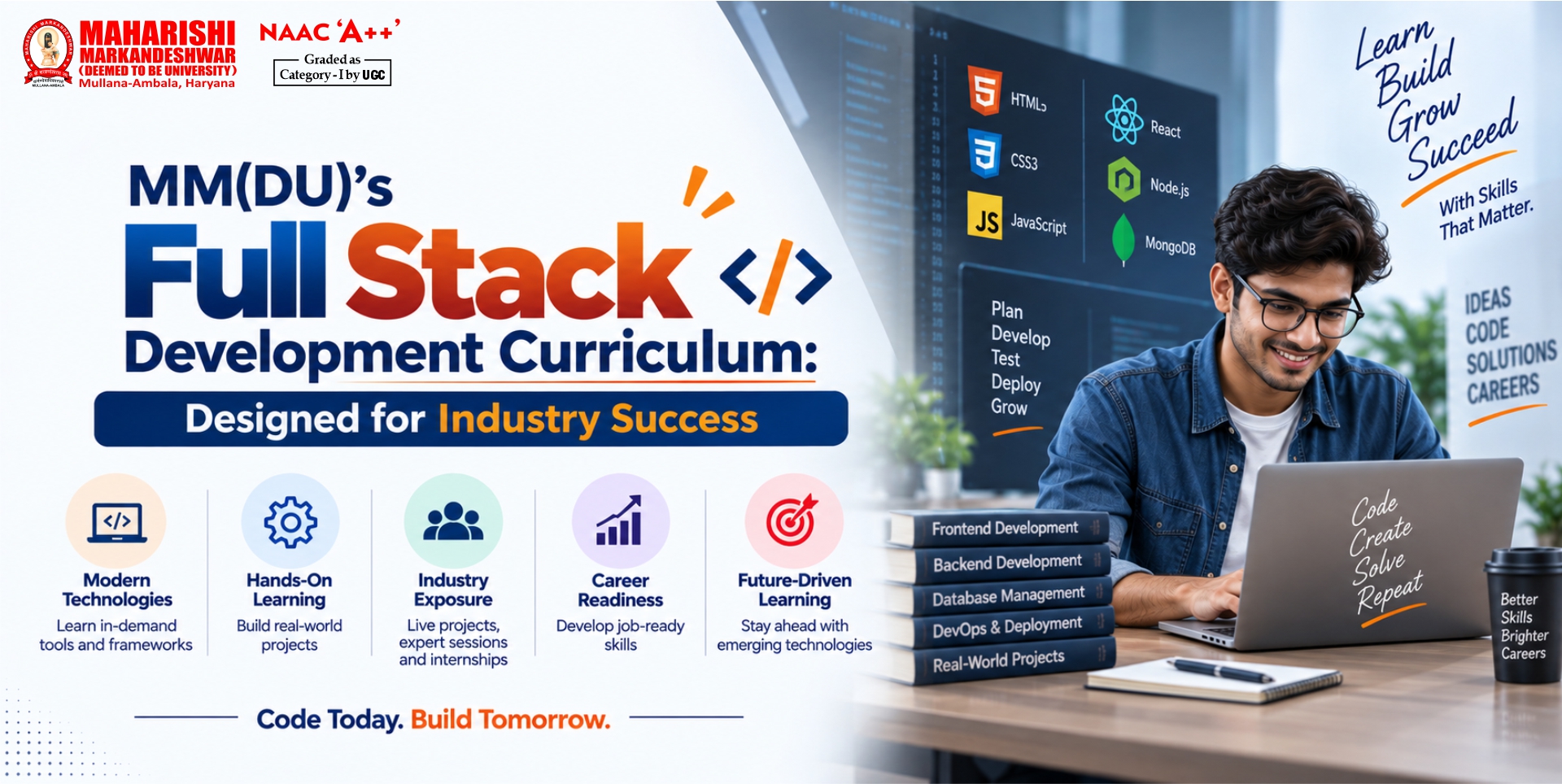
At MM(DU), the Full Stack Development curriculum is designed with a clear focus on building practical skills alongside strong technical foundations. The objective is not simply to teach students programming languages, but to help them understand how modern applications are planned, developed, tested, deployed and maintained.
Learning Beyond Programming
Full Stack Development covers much more than frontend and backend coding. It gives students an understanding of the complete development cycle of a digital product.The curriculum introduces students to the technologies and concepts required to build responsive user interfaces, develop powerful backend systems, manage databases, work with APIs and understand deployment environments. This broad exposure helps students see the bigger picture rather than learning individual technologies in isolation.
For a student, this approach is important because real-world software development rarely happens within a single technology. A developer may be expected to work across multiple layers of an application, collaborate with designers and backend teams, understand databases and troubleshoot problems across the development process.A full stack approach prepares students for exactly this kind of working environment.
Strong Foundations, Modern Technologies
Technology changes quickly, but strong fundamentals remain valuable throughout a developer’s career.A well-designed curriculum therefore needs to strike a balance between foundational knowledge and current industry practices. Students need to understand programming logic, data structures, databases and software development principles while also becoming familiar with modern frameworks, tools and development methodologies.
At MM(DU), the curriculum is structured to provide this balance.
Students can develop proficiency across areas such as HTML, CSS and JavaScript for frontend development, along with modern frameworks and backend technologies. Database management, APIs, version control and application development further expand their technical capabilities.The focus is on understanding how these technologies work together.
That matters because employers increasingly value developers who can think beyond a single programming language or tool and understand how different components contribute to a complete digital solution.
Learning Through Projects
One of the biggest differences between learning technology in theory and becoming job-ready is practical exposure.Writing a program for an examination is very different from building an application that needs to solve an actual problem.
Project-based learning helps bridge this gap.
By working on projects, students get opportunities to translate concepts into working applications. They learn to plan a solution, write and organise code, identify errors, test functionality and improve their work based on feedback.Projects also develop something that cannot be learned entirely from textbooks: problem-solving ability.
Whether students are developing a website, creating a database-driven application, building an API or working on a more complex full stack project, each experience teaches them how to approach technology as a solution rather than simply as a subject.
Understanding the Complete Development Lifecycle
A successful application is not just about writing good code.Students also need to understand what happens before and after development.
A strong Full Stack Development curriculum exposes learners to different stages of the software development lifecycle, including planning, development, testing, debugging, version control and deployment.This broader perspective helps students understand how professional development teams operate.
They can learn how different developers collaborate on the same project, how code is managed, how applications are tested and how software moves from development environments to real users.These are practical skills that can make the transition from classroom to workplace much smoother.
Preparing Students for Industry Expectations
The technology sector values adaptability.A student may graduate with knowledge of a particular framework, but the tools used by companies can change over time. The ability to learn, adapt and solve unfamiliar problems is therefore just as important as technical knowledge.
An industry-oriented curriculum encourages students to develop this mindset.Instead of treating technology as a fixed collection of subjects, students are encouraged to understand concepts and apply them in different situations. This helps them become more comfortable with learning new tools and technologies as their careers progress.
The curriculum can also help students understand professional practices such as collaborative development, documentation, testing and version control—skills that are increasingly relevant in modern software teams.
Building More Than Technical Skills
A successful technology professional needs more than technical expertise.
Communication, teamwork, analytical thinking, presentation skills and the ability to explain technical ideas clearly are equally important in a professional environment.
Full Stack Development projects naturally create opportunities to develop these skills. Students working in teams have to divide responsibilities, discuss solutions, resolve challenges and present their work.
This combination of technical and professional skills can help students become better prepared for interviews, internships and workplace responsibilities.
From Classroom to Career
The ultimate purpose of an industry-focused curriculum is to make learning relevant to career aspirations.
Full Stack Development can open pathways across a wide range of technology roles, including frontend developer, backend developer, full stack developer, web application developer, software developer and related technology positions.
However, the real advantage lies in giving students a broad foundation from which they can choose their area of specialisation.
Some may develop a deeper interest in frontend technologies and user experiences. Others may prefer backend architecture, databases or APIs. Some may eventually move towards cloud technologies, DevOps, artificial intelligence or product development.
A strong full stack foundation gives students the flexibility to explore these directions.
MM(DU) Advantage
For students choosing a technology programme, the question should not only be, “What will I study?”A more important question is, “How will this prepare me for the world I want to work in?”MM(DU)’s approach to Full Stack Development focuses on making education practical, relevant and aligned with the evolving needs of the technology industry. By combining foundational concepts, modern technologies, hands-on projects and professional skills, the curriculum aims to prepare students for the realities of software development.
In an industry where technology keeps evolving, the ability to keep learning is perhaps the most valuable skill of all.The goal, therefore, is not just to create students who can code.
It is to develop future technology professionals who can think, build, solve and adapt.And that is what makes an industry-oriented Full Stack Development curriculum a strong foundation for a successful technology career. Visit this link https://www.mmumullana.org/course/b-tech-computer-science-engineering for more details on Full Stack Development.

