

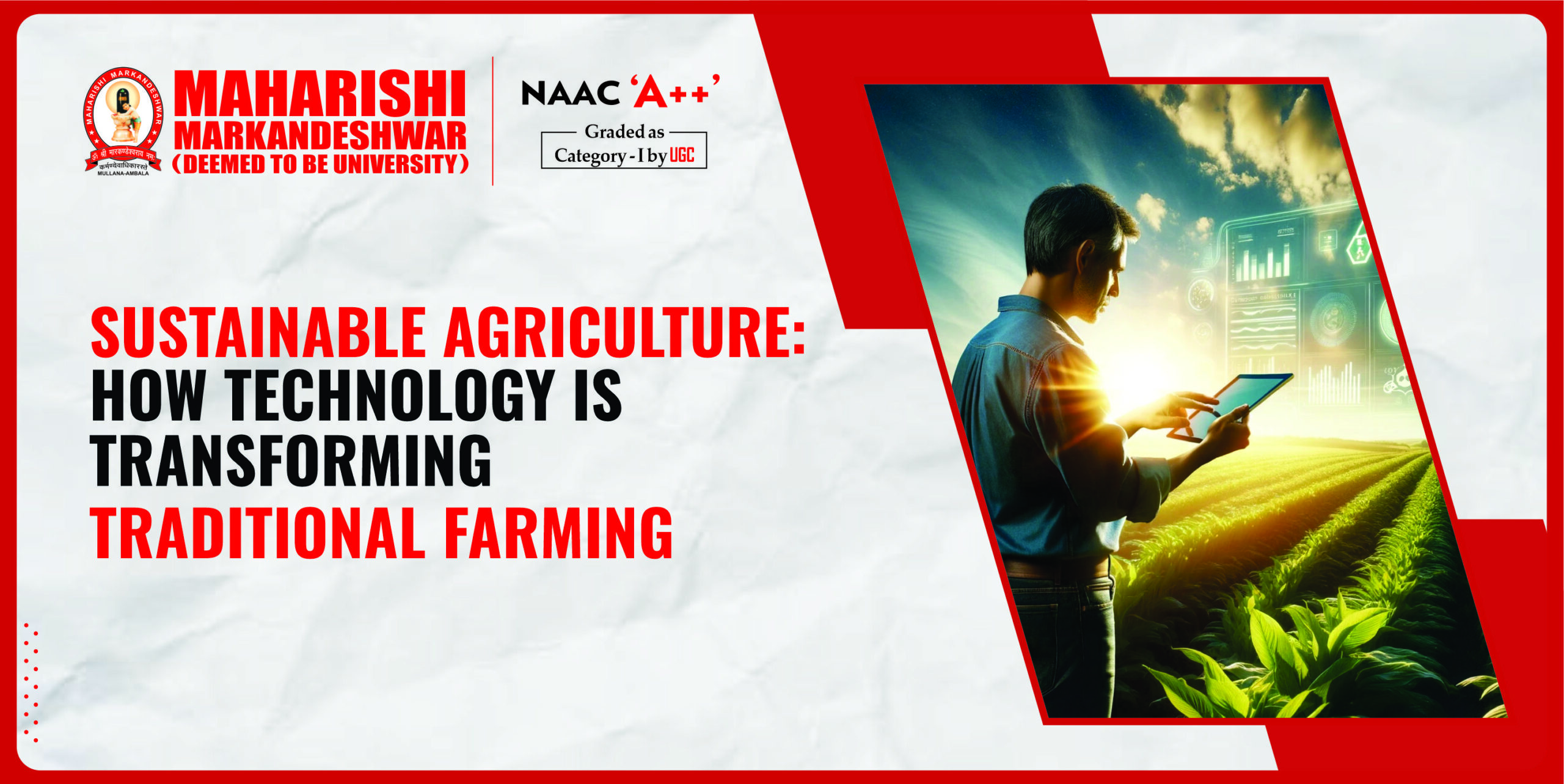
Agriculture has always been the backbone of India’s economy and culture. For centuries, farming practices were guided by traditional knowledge passed down through generations. While these methods have sustained communities for decades, modern challenges such as climate change, shrinking landholdings, water scarcity, rising input costs and growing food demand require innovative solutions. Today, technology is reshaping agriculture, creating a new era of sustainable farming that combines traditional wisdom with scientific advancement.
This transformation, often referred to as Agri-Tech, is not just changing how crops are cultivated; it is redefining the future of food production, environmental conservation, and rural entrepreneurship. As India moves toward becoming a global agricultural powerhouse, the integration of technology into farming is opening exciting opportunities for students, researchers and aspiring agri-entrepreneurs.
The Need for Sustainable Agriculture
Sustainable agriculture focuses on meeting present food needs without compromising the ability of future generations to meet theirs. It promotes practices that protect natural resources, improve soil health, conserve water and reduce environmental impact while maintaining productivity.
India faces several agricultural challenges today. Unpredictable weather patterns, excessive dependence on chemical fertilizers, declining groundwater levels, and post-harvest losses continue to affect farm profitability. Sustainable agriculture offers solutions that balance productivity with environmental responsibility. Technology plays a crucial role in making this balance possible.
Precision Farming: Doing More with Less
One of the most significant developments in modern agriculture is precision farming. Instead of treating an entire field uniformly, precision farming uses data and technology to manage crops more accurately.
Sensors placed in fields can measure soil moisture, nutrient levels, and temperature. Farmers can then apply water, fertilizers and pesticides only where needed. This reduces waste, lowers costs and minimizes environmental damage.For example, a wheat farmer using soil sensors can identify specific areas experiencing moisture stress and irrigate only those sections rather than the entire field. This targeted approach conserves water while maintaining crop health.
Precision farming not only improves yields but also supports sustainable resource management; an essential requirement in regions facing water scarcity.
Drones: The Eyes in the Sky
Drones have emerged as one of the most exciting innovations in agriculture. Equipped with cameras and advanced imaging systems, drones provide farmers with real-time information about crop conditions.A drone can survey hundreds of acres within a short period and identify issues such as pest infestations, nutrient deficiencies, water stress or disease outbreaks before they become visible to the naked eye.
In paddy cultivation, drones are increasingly used for pesticide spraying. Compared to conventional methods, drone spraying is faster, safer, and more precise. Farmers save labour costs, reduce chemical exposure and ensure uniform application across fields.Governments and agricultural institutions across India are actively promoting drone technology because of its potential to improve efficiency while reducing environmental impact.
Internet of Things (IoT): Smart Farming in Action
Internet of Things (IoT) refers to a network of connected devices that collect and share data. In agriculture, IoT is transforming farms into intelligent ecosystems.Smart irrigation systems are one of the most practical applications of IoT. Sensors continuously monitor soil moisture levels and automatically activate irrigation when required. This prevents overwatering and conserves valuable water resources. Similarly, IoT-based weather stations provide localized forecasts that help farmers make informed decisions regarding sowing, irrigation and harvesting.
Imagine a vegetable farmer receiving a mobile alert indicating that soil moisture has dropped below the optimum level. The irrigation system automatically responds, ensuring crops receive the right amount of water at the right time. Such innovations improve productivity while supporting sustainability goals.
Organic Farming and Natural Resource Conservation
While technology is advancing rapidly, sustainable agriculture also emphasizes environmentally responsible cultivation practices.Organic farming has gained significant attention due to growing consumer demand for chemical-free food. Organic methods focus on natural fertilizers, composting, crop rotation, biological pest control and soil conservation.
For example, vermicomposting converts organic waste into nutrient-rich manure that enhances soil fertility naturally. Similarly, integrated pest management reduces reliance on chemical pesticides by encouraging beneficial insects and biological controls.Modern technology is helping organic farmers as well. Mobile applications provide guidance on organic certification, pest identification, market access, and best practices. Digital platforms connect producers directly with consumers, improving profitability and reducing intermediaries.
By combining traditional ecological knowledge with modern scientific tools, organic farming represents a powerful model for sustainable agricultural development.
Artificial Intelligence and Data-Driven Agriculture
Artificial Intelligence (AI) is beginning to play a major role in agriculture worldwide. AI systems can analyse vast amounts of data collected from satellites, drones, sensors, and weather stations.These systems help predict crop diseases, estimate yields, recommend fertilizer application and optimize resource utilization.
For instance, AI-powered image recognition tools can identify plant diseases simply by analysing photographs taken with a smartphone. Early diagnosis enables timely intervention, reducing crop losses and improving farm income.As AI technologies become more accessible, farmers can make more informed decisions and improve resilience against environmental uncertainties.
Agri-Entrepreneurship: The Future of Rural and Urban Youth
Agriculture today extends far beyond traditional farming. The sector is creating opportunities in technology, business, logistics, food processing, consulting and sustainability.
Agri-entrepreneurship is emerging as a powerful career pathway for young people. Innovative startups are developing drone services, smart irrigation solutions, precision farming platforms, organic food brands, supply chain technologies and farm advisory services.
A young entrepreneur does not necessarily need to own farmland to succeed in agriculture. A graduate with expertise in technology and agricultural sciences can establish a drone mapping business, create an agricultural mobile application, launch a hydroponics venture or build a direct-to-consumer organic produce brand.
Urban youth are also increasingly entering agriculture through vertical farming, rooftop cultivation, controlled-environment agriculture, and agribusiness startups. This demonstrates that agriculture is evolving into a knowledge-driven sector offering diverse professional opportunities.
Preparing Future Leaders in Agriculture
As the agricultural landscape evolves, educational institutions play a critical role in preparing future professionals. Students pursuing agricultural sciences today require exposure not only to crop production but also to emerging technologies, sustainability practices, data analytics and entrepreneurship.A modern agricultural education equips students with practical skills in precision farming, drone applications, smart irrigation systems, organic farming techniques, farm management, and agribusiness development. Such interdisciplinary knowledge enables graduates to contribute effectively to both food security and environmental sustainability.
At MM (Deemed to be University), the Faculty of Agriculture is committed to preparing students for the future of farming by blending traditional agricultural knowledge with modern technological advancements. The curriculum goes beyond conventional crop production, providing hands-on exposure to emerging areas such as precision agriculture, drone technology, smart irrigation systems, organic farming, agribusiness management and sustainable farming practices.
Through practical learning, field-based training, research opportunities, and industry-oriented education, students develop the skills needed to address real-world agricultural challenges. By fostering innovation, entrepreneurship, and environmental responsibility, MM (DU) is nurturing a new generation of agricultural professionals who are equipped to enhance food security, promote sustainable development and drive transformation across the agricultural sector.
Visit this link for more details of trending agriculture courses.https://www.mmumullana.org/institute/agriculture/

